
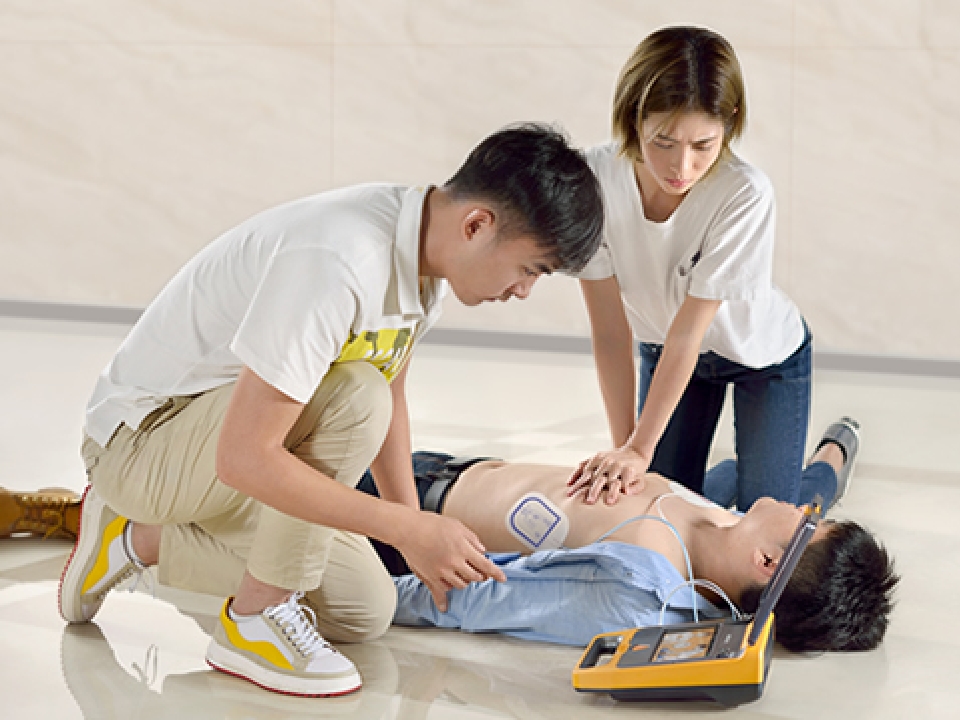
Mindray BeneHeart C2 AED
Mindray BeneHeart C2 AED with QShock first shock in under 8 seconds, ECG analysis in under 5 seconds and ResQNavi adaptive rescue guidance.
ICEN supplies selected professional medical equipment. Product availability and market authorization vary by country.
A public-access AED where the first shock matters most
The Mindray BeneHeart C2 is an automated external defibrillator designed around elapsed time to first shock. QShock technology brings the unit to shock-ready in less than eight seconds from power on at 200 J with a new battery at 20 +/- 5 degC, and the device is pre-charged during ECG analysis, so charge time after the rhythm decision is effectively zero. Rhythm analysis itself takes less than five seconds and meets the AAMI DF80 and IEC 60601-2-4 specifications.
Energy is delivered as a biphasic truncated exponential waveform with automated voltage and duration compensation for patient impedance, at 100 to 360 J for adults and 10 to 100 J for children. The default energy protocol of 200-300-360 J for adults and 50-70-100 J for children meets the AHA/ERC 2015 Guidelines. ResQNavi guidance adapts its animated coaching and voice prompts to the rescuer proficiency level, with adult and child modes and up to three selectable languages; CPR mode can be set to 30:2, 15:2 or hands-only.
The C2 is available in semi-automatic and fully automatic versions and has no manual defibrillation or pacing modes, which suits public-access and workplace deployment. It is rated IP55, survives a 1.5 m drop on six surfaces, and weighs 2.3 kg including one battery. The disposable lithium manganese dioxide battery is rated for at least 12 hours of operating time or 350 shocks at 200 J, with a six-year standby life under weekly auto tests. The unit runs daily, weekly, monthly and quarterly self-tests and transfers data over 5G or 2.4G Wi-Fi or 4G cellular to AED-Alert 2.0. ICEN supplies the BeneHeart C2 to hospitals, workplaces and distributors, and confirms the applicable version and market requirements before quotation.
Applications
- Public-access defibrillation programmes
- Workplace and facility AED deployment
- Ambulance and first-responder backup
- AED fleet management with remote status reporting
Who is this product for?
- Facilities rolling out public-access AEDs
- Workplaces and campuses with trained first responders
- Emergency services needing a compact backup AED
- Distributors supplying AED programmes
Selected Product Highlights
Specifications below are presented from the current ICEN product catalog. Confirm final configuration and technical documents with our team before purchase.
QShock: shock-ready in under 8 s from power on; pre-charged during ECG analysis
ECG rhythm analysis in under 5 s, meeting AAMI DF80 and IEC 60601-2-4
100-360 J adult and 10-100 J child, biphasic truncated exponential (BTe) waveform
ResQNavi adaptive guidance; CPR mode 30:2, 15:2 or hands-only
Semi-automatic and fully automatic versions; no manual or pacing modes
IP55, 1.5 m drop on six surfaces, 2.3 kg; 350 shocks at 200 J per battery
Mindray BeneHeart C2 AED - key specifications
| Brand | Mindray |
|---|---|
| Model | BeneHeart C2 |
| Category | Automated External Defibrillator (AED) |
| Manual / AED / pacing modes | Available in semi-automatic and fully automatic versions; no manual defibrillation or pacing modes |
| Defibrillation energy | 100 to 360 J (adult); 10 to 100 J (child) |
| Energy default | 200-300-360 J (adult); 50-70-100 J (child); default configuration meets AHA/ERC Guidelines 2015 |
| Energy accuracy | +/-2 J or +/-10 % of setting, whichever is greater |
| Waveform | Biphasic truncated exponential (BTe), with automated voltage and duration compensation for patient impedance |
| Time to first shock | Less than 8 s from power on to shock ready (200 J, new battery, 20 +/- 5 degC) |
| Power on time | Less than 2 s |
| ECG analysis time | Less than 5 s |
| Charge time | 0 s (device is pre-charged during ECG analysis) |
| Shockable rhythm analysis algorithm | Meets AAMI DF80 and IEC 60601-2-4 specifications |
| Patient impedance range | 25 to 300 ohm |
| Display | 7 inch TFT Color LCD, 800 x 480 pixels, auto screen brightness |
| Rescue guidance | ResQNavi adaptive guidance: step-by-step animated coaching and voice prompts that adapt to rescuer proficiency; adult/child mode; up to 3 selectable languages |
| CPR feedback | CPR coaching with animation and voice guide plus CPR metronome; CPR real-time feedback and CPR results require the CPR sensor; CPR mode configurable as 30:2, 15:2 or hands-only |
| User prompts | On-screen text and animation prompts plus voice prompts |
| Battery | Lithium manganese dioxide (Li/MnO2), disposable, 4200 mAh, 300 g |
| Battery standby life | 6 years at 20 +/- 5 degC with weekly auto test; 5 years at 20 +/- 5 degC with daily auto test (not in use, not sending self-test report) |
| Battery capacity | At least 12 hours operating time; provides 350 shocks at 200 J (3 shocks in 1 minute); minimum 10 shocks at 200 J and 30 minutes operating time after replace-battery indication (at 20 +/- 5 degC, typical) |
| Electrode pads | Pre-connected, disposable, for adult/child; shelf life 5 years from date of manufacture |
| Self-test | Automatic self-test daily, weekly, monthly and quarterly; visual status indicator for system readiness |
| Protection / ingress rating | IP55 water-/dust-proof |
| Drop resistance | 1.5 m (6 surfaces) |
| Dimensions | 210 mm (w) x 286 mm (d) x 78 mm (h) |
| Weight | 2.3 kg (including one battery) |
| Operating temperature | -5 to 50 degC; short-term storage -30 to 70 degC for a maximum of 7 days; long-term storage 15 to 35 degC |
| Humidity / altitude | Operating and storage 5 to 95 % (non-condensing); operating and storage altitude -381 m to +4575 m |
| Data storage | Up to 500 events; up to 1 hour voice recording; up to 5 hours CPR data; 1000 self-test reports; data export through USB flash memory |
| Connectivity | Wireless data transfer through 5G/2.4G Wi-Fi or cellular (4G) to the AED-Alert 2.0 system |
| Regulatory / certifications | Meets AAMI DF80 and IEC 60601-2-4; IEC 60601-1-2:2014; IEC 60601-1-12; RTCA-DO-160G-2010 Section 7; MIL-STD-810G-2008 vibration (methods 514.6 categories 13, 14, 20, 24); EN 13718-1; EN 1789; complies with EU GDPR via AED-Alert 2.0 |
| CPR sensor (optional) | Weight approximately 180 g (without battery); thickness 17.5 to 19 mm |
See Mindray BeneHeart C2 AED in action
Watch the verified manufacturer video associated with this model.
Our buying guide sets out how to compare defibrillator/monitor specifications; the models below cover different monitoring depths, display sizes and battery configurations.
Common questions about Mindray BeneHeart C2 AED
How fast is the BeneHeart C2 to first shock?
Under 8 seconds from power on to shock-ready at 200 J with a new battery at 20 +/- 5 degC. Rhythm analysis takes under 5 seconds and the device is pre-charged during analysis, so charge time after the decision is effectively zero.
What energy does the C2 deliver?
100 to 360 J for adults and 10 to 100 J for children, using a biphasic truncated exponential waveform with automated voltage and duration compensation for patient impedance. The default protocol of 200-300-360 J (adult) meets AHA/ERC 2015 Guidelines.
Is the C2 semi-automatic or fully automatic?
Both versions exist: the BeneHeart C2 is the semi-automatic version and the BeneHeart C2 Fully-Auto is the fully automatic version. Confirm which version your market requires with ICEN.
Does the C2 have manual defibrillation or pacing?
No. The C2 is a dedicated AED with no manual defibrillation or pacing modes, which suits public-access and workplace deployment.
How long does the battery last?
The disposable lithium manganese dioxide battery provides at least 12 hours of operating time or 350 shocks at 200 J, with a 6-year standby life under weekly auto tests and 5 years under daily auto tests.
Can ICEN provide a quotation?
Yes. Send the model, quantity, destination market and required configuration through the Request a Quote button.
Related products and resources
Need a quotation or product configuration?
Send the model, estimated quantity, destination market and required configuration - our export team will reply with availability, documentation and pricing.